
Tortuguero: The Amazon of Costa Rica
- Cecilia Markley

- Mar 21
- 6 min read
Published on Travelbinger

If you’ve always wanted to see the Amazon rainforest, with its wealth of biodiversity and famous Amazon River, but can’t make the difficult journey to get there, Tortuguero, Costa Rica might just be the next best thing.
I visited with my boyfriend in December, and it was my favorite place we went to in Costa Rica.
What Is Tortuguero?

When talking about Tortuguero, I should differentiate between the village, the national park, and the conservation area. All bear the name Tortuguero but are distinct. You stay in the village of Tortuguero and pay for entrance to Tortuguero National Park, which is located within the Tortuguero Conservation Area.
Located on the Caribbean coast in northeastern Costa Rica, the village of Tortuguero is only accessible by boat or plane. This is because the Tortuguero River and a series of canals separate the village from the mainland. The village is essentially a narrow sandbar sandwiched between the Caribbean Sea and the Tortuguero River.
With a population of around 1,500, the city is sustained by eco-tourism, but also boasts four research stations around the village. The beaches along Tortuguero are key nesting sites for four sea turtle species. The park hosts an astonishing biodiversity of animals, such as insects, birds, monkeys, sloths and jaguars.
Getting to Tortuguero

Our destination before Tortuguero was La Fortuna, so to get from La Fortuna to Tortuguero required us to take four buses to reach La Pavona. Here is where the primary public docks for boats to the Tortuguero village are located. The last boat for Tortuguero leaves at 4:30 pm, so we had to make sure to arrive at the dock before that.
Upon arrival in La Pavona, we were swarmed by boat captains trying to get us to choose their boat. Feeling overwhelmed, we went with the first man who approached us and asked his price. He charged us the normal price, 4,000 CRC (around $8). At 4:30 p.m., we were loaded onto his boat and began our river journey.
It takes about an hour and a half to get from La Pavona to the village of Tortuguero via boat. The scenic ride takes you along the Tortuguero River, surrounded by towering trees, mangroves, swamps, and animals of all kinds. If you’re lucky like we were on the boat ride back, you may even get to see turtles hanging out on the rocks on the riverbank.
Why Go to Tortuguero?

Tortuguero means land of turtles, and that is what the village is most famous for and what attracts many of its tourists every year. Four species of sea turtles, two of which are critically endangered, come ashore to lay eggs along the beach in the summer and fall. In September and October, some tourists come to watch and even assist as the eggs hatch and the baby turtles emerge.
We learned while we were here, though, that in Tortuguero, this practice is not permitted and is very unsafe for the baby turtles. Only professionals should be handling them.
There is plenty to do in Tortuguero beyond turtles, though. Two of the most popular activities, and what my boyfriend and I chose to do, are a night walk through the jungle and a canoe tour through the Tortuguero River and canals.
Beyond tours, the town is a great place to just hang out. The beach is nice to walk along, although you should not swim in the water, as the currents are strong and dangerous, and the water is known to be inhabited by sharks and barracudas. The hostel where we stayed was owned by a very sweet local woman through whom we booked our tours, and there are plenty of restaurants and a centrally located grocery store.
Jungle Night Tour

It was my boyfriend’s birthday, and he thought a jungle night tour would be a cool way to end the day. We booked our tour through our hostel the day we arrived, spending just $20 per person. We spent the day walking along the beach and enjoying a nice lunch, and then at 6 p.m., our tour guide Leroy met us outside our hostel.
We only had one flashlight between the two of us, but luckily Leroy had an extra. If you decide to go on a night walk in Tortuguero, make sure you have a flashlight. I also highly recommend hiking shoes or boots, and either long pants or tons of insect repellent. You are in the jungle, after all, so there will be mosquitoes.
We spent the subsequent two hours after meeting our guide, and the one other member of the group, walking along a path outside the brush and eventually entering the tall trees themselves and trusting Leroy’s navigation skills to get us out the other side unscathed.
It was a magical night. We saw just about every animal one could have on a Costa Rica bucket list: red-eyed tree frog, toucan, sloths, exotic spiders and insects, and even a boa constrictor and other snakes.
We even walked onto the beach and Leroy pointed out the already-hatched turtle nests, recognizable due to the hundreds of empty turtle shells. He explained that most baby turtles don’t survive due to predation from local animals and debris on the beach.
Canoe Tour

The next morning, we woke up early to meet Leroy again, but this time it was at the main docks for a canoe tour through the river and into the canals at 6 a.m. I recommend that anyone who wants to do a river tour at Tortuguero go in a canoe. The motorboats may seem appealing as you can get around faster and can sit back and relax, but they can’t get into the tight, shallow canals the same way a canoe can. Additionally, canoes cause much less of a disturbance and are safer for the wildlife than motorboats.
Our canoe tour also cost $20 per person, but there is an added fee to that. The part of the river and canals where the tours take guests is recognized as part of Tortuguero National Park, so guests on river tours must also pay the park entry fee of $15.
With Leroy as our guide, and the other three in our group, we all paddled along the river and into the canals on a two-hour journey on which we saw iguanas, caimans, and the best view I had of a sloth during my whole time in Costa Rica. We spotted dozens of species of birds, but neither my boyfriend nor I had binoculars to see the faraway animals closely. Luckily, another woman in the group lent us hers to get the best views.
One of the most incredible parts of the tour was navigating the canoe into the tight canals where we were swallowed by mangroves. Here, when I paused to just take it all in, I really felt like I was living in the rainforest amongst the animals, even if just for a few brief moments.
Tortuguero National Park
After our late night and early morning, we decided upon returning to our hostel on a midday nap. We awoke in the early afternoon feeling refreshed, and headed to the land part of Tortuguero National Park. We had already paid for entry to the park for the day, so we wanted to take full advantage and see as much as possible.
The full park is massive, covering tens of thousands of acres. However, there is just one trail, the Jaguar Trail, that is publicly accessible to park visitors. The Jaguar Trail is an out-and-back trail, approximately 3.7 miles (6 kilometers) total.
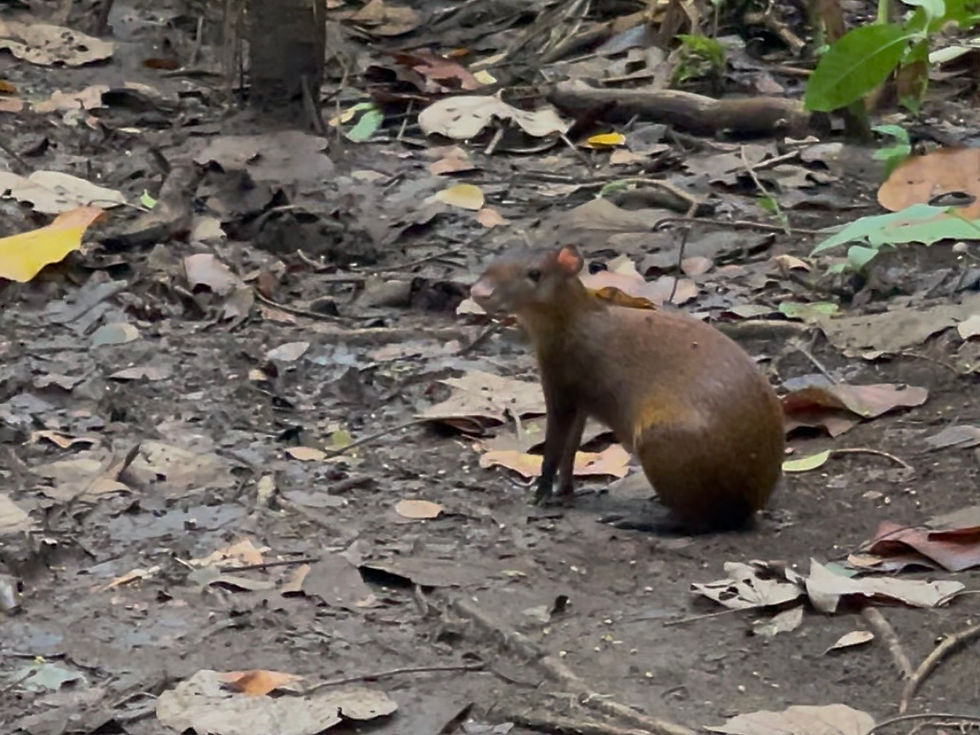
We strolled along the flat but muddy trail for a few hours and saw beautiful nature the whole way, as well as spotting monkeys and even getting up close to an agouti, a rodent native to Central America. While walking, we noticed that along the way, about every quarter mile or so, there are paths that lead to the beach. We learned these paths are there in case anyone encounters a jaguar while on the aptly named trail. In this unlikely scenario, you should head slowly toward the beach while staying calm, making yourself look big, and never turning your back.
Our final day in the village we spent relaxing around town, and the following day, our three days in Tortuguero came to an end. We headed back to the mainland and continued on our journey with the memories of the friendly people, stunning wildlife, gorgeous beaches, and incredible nature we had just experienced.


Comments